Regina George
Mean GirlsRegina George is the queen bee of North Shore High School: admired, imitated, and feared, she can make social status seem effortless while shaping the behavior and reputations of the people around her. Her rise depends on a carefully maintained public image, but the same power that lets her define others eventually makes her the focus of the school’s collective judgment. Her arc moves from a commanding entrance and confident social rule-making to exposure, injury, and a different kind of belonging through sports.
Identity and Introduction
Regina first appears to Cady Heron as a spectacular public presence. At the gym, a crowd parts for her as muscular jocks carry her on their shoulders; she poses for her admirers, while Damian describes her as the queen bee and her companions as workers. The image makes the school’s hierarchy legible in a single tableau: Regina is not merely popular but treated as its star and organizing center.
Cady’s initial impression is openly hostile. She calls Regina evil and describes her in a string of insults, yet the scene also shows why the insults coexist with fascination: Regina’s confidence draws a crowd, and even a newcomer trying to understand the school is directed to collect opinions about her. Her reputation is already public currency. People have things to say about Regina, and learning who she is means learning how the school talks about her.
Regina’s authority is not limited to spectacle. When Jason Mandrino makes Cady uncomfortable, Regina intervenes, asks whether he is bothering her, and calls him a creep. The interruption complicates her role as a feared social ruler: in this moment, she uses her standing to stop an unwelcome approach. Her influence can protect as well as intimidate, though the scene does not erase the wider pattern of control that defines her relationships.
Social Power and the Management of Image
Regina understands appearance as a form of social leverage. At Chris’s Halloween party, she arrives late with Gretchen Wieners and Karen Smith, dressed in a revealing bunny costume, and interprets the other girls’ attempts to copy her as proof of her influence. She watches Gretchen scan the room for Jason and reads her friend’s anxious attention as another familiar weakness. Regina’s commentary reveals a social order in which she treats imitation as tribute and vulnerability as something to judge.
The party also shows how closely she observes the people around her. While Gretchen and Karen stand by the fireplace, Regina tracks their gestures and infers that their conversation concerns boys; she recognizes Gretchen’s search for Jason without needing to hear the exchange. This attention helps her maintain her position, but it also reduces her friends to predictable performances. Their desires become material for Regina’s private assessment rather than matters she approaches with care.
Cady’s growing place among the Plastics exposes the attraction and cost of Regina’s world. During the Christmas talent-show performance, Cady is onstage beside Regina, following the choreography and feeling the pull of being chosen for Regina’s kingdom even while she hates Regina for lying to her and taking Aaron Samuels. For a moment, belonging feels real enough to blur the difference between the person Cady is trying to oppose and the idealized figure she wants to be near. The moment ends without restoring Cady’s trust: the excitement of performing together does not change Regina’s character or Cady’s plans.
Conflict, Betrayal, and Retaliation
Regina’s account of her history with Janis Ian places one source of their long conflict in middle school. She says that she and Janis were best friends, then describes becoming involved with her first boyfriend, Kyle, who later moved to Indiana. Regina resented Janis’s jealousy and, for her birthday pool party, excluded her by claiming she thought Janis was a lesbian. Cady recognizes this as the origin of the rumor that helped isolate Janis. Regina presents the exclusion as justified, but her own explanation makes clear that a friendship’s ordinary claims on her attention became, in her telling, a reason to reject and label her former friend.
That history matters when Cady becomes caught between Regina’s circle and Janis’s plan to undermine it. Regina’s account gives Cady information about the origin of Janis’s ostracism, but Cady does not openly challenge her. The gap between what Regina says and what Cady understands shows how Regina’s control works through conversation as much as through public display: she supplies a version of events that invites agreement, and her listener has to decide whether to accept it or risk standing against her.
When Cady’s behavior at her party leaves Regina angry, Regina interprets the situation through the Girl Code and her ex-boyfriend. She does not stay for a conversation with Cady, saying she would not have wanted to listen even if Cady had been sober. Her response stresses the injury she believes she has suffered, while setting aside the larger history of manipulation and rivalry that brought them there.
The Burn Book turns that private, retaliatory mode into a school-wide crisis. Regina says that before handing the book to Principal Duvall, she made stacks of copies of every page and scattered them through the halls of North Shore High School. The choice transforms a collection of insults into a mass circulation event: the material is no longer contained among its authors, and its effects spread through the school. During the resulting turmoil, Janis sees her page, which labels her with an anti-gay slur. Regina recalls that Cady had written the phrase “Too gay to function” earlier in the year, and she frames the insult as confirmation of Cady’s betrayal. The episode makes the book’s harm visible not only as gossip but as stigmatizing language directed at people whose reputations and relationships are already vulnerable.
Public Reckoning and Injury
At Ms. Norbury’s workshop, Regina tries to define the crisis on her own terms. She argues that the school does not have a clique problem and that some people should be excused because they are victims. She admits in her narration that she started the Burn Book and released it across the school, but blames Cady for crossing her and presents herself as the injured party. Her defense reveals the distance between acknowledging an action and accepting responsibility for its consequences.
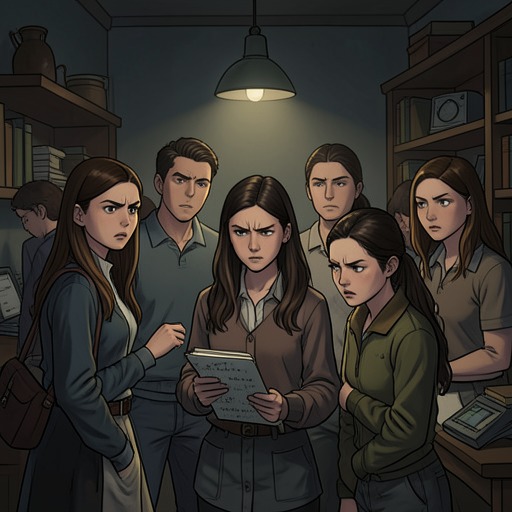
Ms. Norbury then asks who has ever felt personally victimized by Regina. The room falls quiet before every girl raises a hand; even the adults join in, and Principal Duvall slowly adds his hand to the group. This response makes Regina’s private certainty collide with a shared judgment. Her social power had depended on controlling how others were seen and spoken about; now the people around her publicly name their experience of her. The scene does not leave room for her to dismiss the result as one person’s grievance.
Janis’s apology speech reveals another part of the conflict. She explains that she convinced a new student to help mess up Regina’s life. Regina reacts with anger when she understands that the student was Cady, and she insists that she does not care whether everyone hates her because ruling through fear still counts as ruling. The claim preserves the language of dominance at the very moment her authority is being exposed as coercive and unstable. When she confronts Cady, she calls her a homeschooled jungle freak and a less attractive version of herself, turning the labels she has used to define others back on the former ally who has helped bring her down.
The confrontation is abruptly interrupted by a car horn and the arrival of a vehicle. Regina is hit by a bus and suffers a spinal injury. The accident ends the immediate argument and sharply changes her circumstances: the girl who had made herself the center of the school’s attention becomes a patient surrounded by visitors. Her injury is a consequence of the unfolding confrontation, not a resolution of the social conflicts that preceded it.
Recovery and Aftermath
Cady later visits Regina with white azaleas. Regina is in bed with her head immobilized in a spinal halo, surrounded by students; Mrs. George sits beside her with a dog on her lap. Regina avoids looking at Cady, and Mrs. George tells Cady where to leave the flowers. The visit records both a changed balance and an unfinished relationship: Cady can enter Regina’s home and offer a gesture of reconciliation, but Regina is not ready to meet that gesture directly.
One year later, the Plastics have broken up. Regina’s spine has healed, and her physical therapist has helped her channel her anger into sports. She joins the lacrosse team, where the jock girls are no longer afraid of her because she is now on the same team. The shift does not present her as having ceased to be forceful; instead, it places that force in a shared activity where the people around her are teammates rather than subjects of her social rule.
Regina’s ending therefore changes the conditions of her power rather than restoring her old reign. The school’s social structure has moved on, and her former position as queen bee no longer organizes the Plastics or the student body. Her recovery and participation in lacrosse leave open the possibility of belonging without fear as its price, while the breakup of the group confirms that the earlier order has not simply reassembled around her.